
"We Record Everything. We Remember Almost Nothing."
A cybersecurity researcher took the question to the Supreme Court. On 19 May 2026, the Court handed it to the government. The question is bigger than either of them.

The first time I understood something was wrong, I was not looking at a constitutional question. I was looking at records.
Pages of them. Reports. Reference numbers. Official communications, acknowledgements, responses — all generated by systems built to record, verify, track and preserve. On paper, everything existed. Yet the simplest question had no answer: what actually happened?
Years later I met the same question again. Different institution, different technology, different people — the same silence. The records existed. The understanding did not.
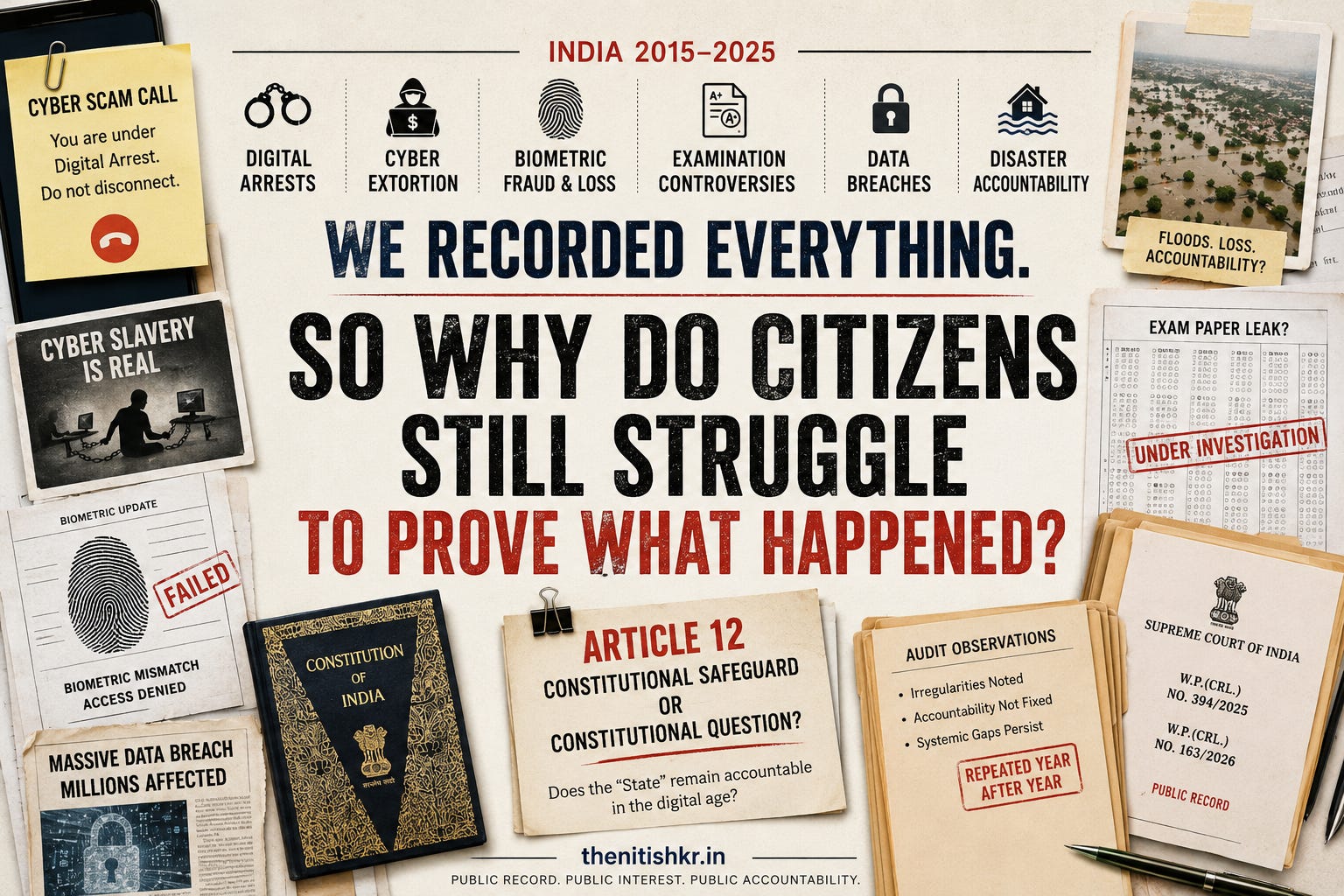
For a long time I assumed the problem was missing information. It was not. India was generating more information than at any point in its history. Government systems, financial systems, identity systems, digital platforms, citizens themselves — all of it producing records at a scale few societies have ever matched. We were becoming one of the most documented civilizations on earth. And still, in courtroom after complaint after audit, the same five words surfaced: what happened, and who is accountable?
Information was surviving. Continuity was not. Somewhere in that gap — between the data we keep and the understanding we lose — a constitutional question began to form.
Article 12 of the Constitution exists for a reason. It names “the State” because accountability requires a visible relationship between power and responsibility. The logic is simple: power exists, responsibility exists, accountability follows. But what happens when the systems exercising power become digital, distributed across dozens of portals, databases and agencies, and increasingly impossible for an ordinary citizen to read? What happens when the records exist — but the continuity that gives them meaning quietly disappears?
I followed that question for more than thirteen years. Not as a politician, not as an institution, not as a media house. As a citizen. The earliest sketch I can date sits at 25 April 2012 — an intelligence-flow diagram I drew to understand how a signal becomes knowledge. No platform, no architecture, no roadmap. Only the question.
That question eventually became a body of work — public records, RTI responses, audit observations, cyber-security research, two books, and a constitutional argument — and, more recently, a courtroom.
On 19 May 2026, the Supreme Court of India heard W.P.(Crl.) No. 163/2026. A three-judge Bench led by Chief Justice Surya Kant, with Justices Joymalya Bagchi and Vipul M. Pancholi, considered a petition I argued in person: that the personal data of Indian citizens — including biometric identifiers such as fingerprints — has allegedly been exfiltrated to servers in at least five foreign jurisdictions, and is being weaponised back against Indians through “digital arrests,” extortion and transnational fraud. The petition asked for the Digital Personal Data Protection Act, 2023 to be operationalised, for a mechanism to recover or destroy stolen data, and for a dedicated investigative apparatus to monitor it.
The Court did something revealing. It held that the questions were too technical for the judicial forum at this stage — and directed the Ministry of Electronics and Information Technology to examine the petition as a representation. The certified order was forwarded to the Secretary, MeitY, “for your information, necessary action and compliance.”
Read that carefully, because it is the whole point of this essay. The Court did not say the problem was small. It said the problem belonged on the government’s desk, not the judge’s. The question had outgrown the courtroom. It did not disappear — it changed addresses.
I have since placed the same record before MeitY, CERT-In, the Prime Minister’s Office and the law officers of the Union, in representations dated 20 May 2026. As of today, the clock I am watching is a simple one: whether the State treats “necessary action and compliance” as a sentence to be acted on, or a sentence to be filed.
This is where information and continuity collide in real life. The petition runs to roughly six thousand pages. A citizen can hold ten documents and still fail to reconstruct a timeline. A researcher can hold thousands of pages and still struggle to see the relationships between events. A journalist can access the record and still spend weeks connecting the chronology. The bottleneck was never collection. It was continuity — the ability of a society to remember what its own records mean.
That realisation is what produced DISHA — a six-layer civic intelligence architecture I have been building since 2013, designed not to count alerts but to preserve evidence of when the State fails its citizens inside digital systems. But DISHA is not the story. It is a by-product. The story is the question that created it: how does a society preserve understanding?
I publish all of this in the open, at thenitishkr.in, precisely so that no one has to take my word for it. The records are there. Readers are free to examine them, agree, disagree, or reach entirely different conclusions. That is not a weakness of the argument; it is the point of it. A republic does not grow stronger by collecting more information. It grows stronger by preserving enough continuity to understand what that information means.
We like to call this the age of information. I have come to suspect it is becoming the age of memory — and that the question defining the next decade is not how much data we can capture, but whether we can preserve enough understanding to know what happened once we have.
We record everything.
The open question — now sitting in a Ministry, not a courtroom — is whether we remember enough to understand it.
Nitish Kumar writes and publishes as thenitishkr. He is a National Cyber Security Scholar certified under the National Security Database, author of Era of Stupidity: Citizen Not Found (ISBN 978-93-5592-012-6) and Sleeping Guardians: India Lost Justice*, and the inventor of the DISHA Intelligence Architecture. He is not the politician of the same name. The full public record, including W.P.(Crl.) No. 163/2026, is at thenitishkr